






Article: Getting Back Into Pilates After A Break
Getting Back Into Pilates After A Break
Getting back into Pilates after a break is mostly a mental problem dressed up as a physical one. You have lost less than you think. Your body remembers more than you expect. The thing most likely to derail you is not weakness, it is trying to pick up exactly where you left off.
Whether you stopped for 2 weeks or 2 years, because of work, travel, a baby, an injury or just life, this is how to come back without being wrecked by day 3 and quitting again by week 2.
In this article
What you actually lose, and what you keep
The good news first. Body awareness and technique stick around far longer than strength does. You will still know how to find a neutral spine, how to breathe through an exercise and what a good footwork position feels like. That is the hardest part of Pilates to learn and you do not have to learn it again.
What fades is the capacity to do it for long. Endurance in the deep abdominals, strength in the glutes and inner thighs, and the ability to hold a position for the last few reps of a set all come down while you are away. The longer the break, the further they come down.
The result is a mismatch that catches almost everyone. Your brain knows the exercise and wants to do it at your old springs, while your muscles are no longer ready for that load. That gap is where people get very sore, lose form, or get hurt.
How long was your break
Use this as a rough guide for where to start. If in doubt, start one level lighter than you think you need.
1 to 3 weeks off. You have lost very little. Go back to your usual classes but drop one spring on the hardest exercises for the first week, and expect a bit more soreness than normal.
1 to 3 months off. Treat your first fortnight as a rebuild. Shorter classes, lighter springs across the board, and 2 sessions a week rather than your old number. Most people are back to their previous level within a month or so of consistent work.
6 months or longer. Start again as a confident beginner. You keep your technique, but approach the load and the volume as if you are new. Our reformer Pilates progressions guide is a useful map for building back up in order.
Your first session back
The goal of your first session is not to get a good workout. It is to finish feeling like you could do it again tomorrow. If you get that right, everything else follows.
- Pick a shorter class. Somewhere between 10 and 30 minutes is plenty. A full length class on day 1 is how you end up unable to walk down stairs on day 2.
- Drop your springs. Take one spring off your old setting for anything heavy, or move to a lighter spring if you only used one. You can always add load next session.
- Spend longer on footwork. Footwork reconnects you with the machine, warms up the legs and lets you check your alignment before anything more demanding.
- Leave out your hardest exercises. Whatever you used to find most challenging, leave it out this time. It will still be there next week.
- Stop with something left. Finish the session feeling like you could have done more. That feeling is what gets you back on the machine 2 days later.
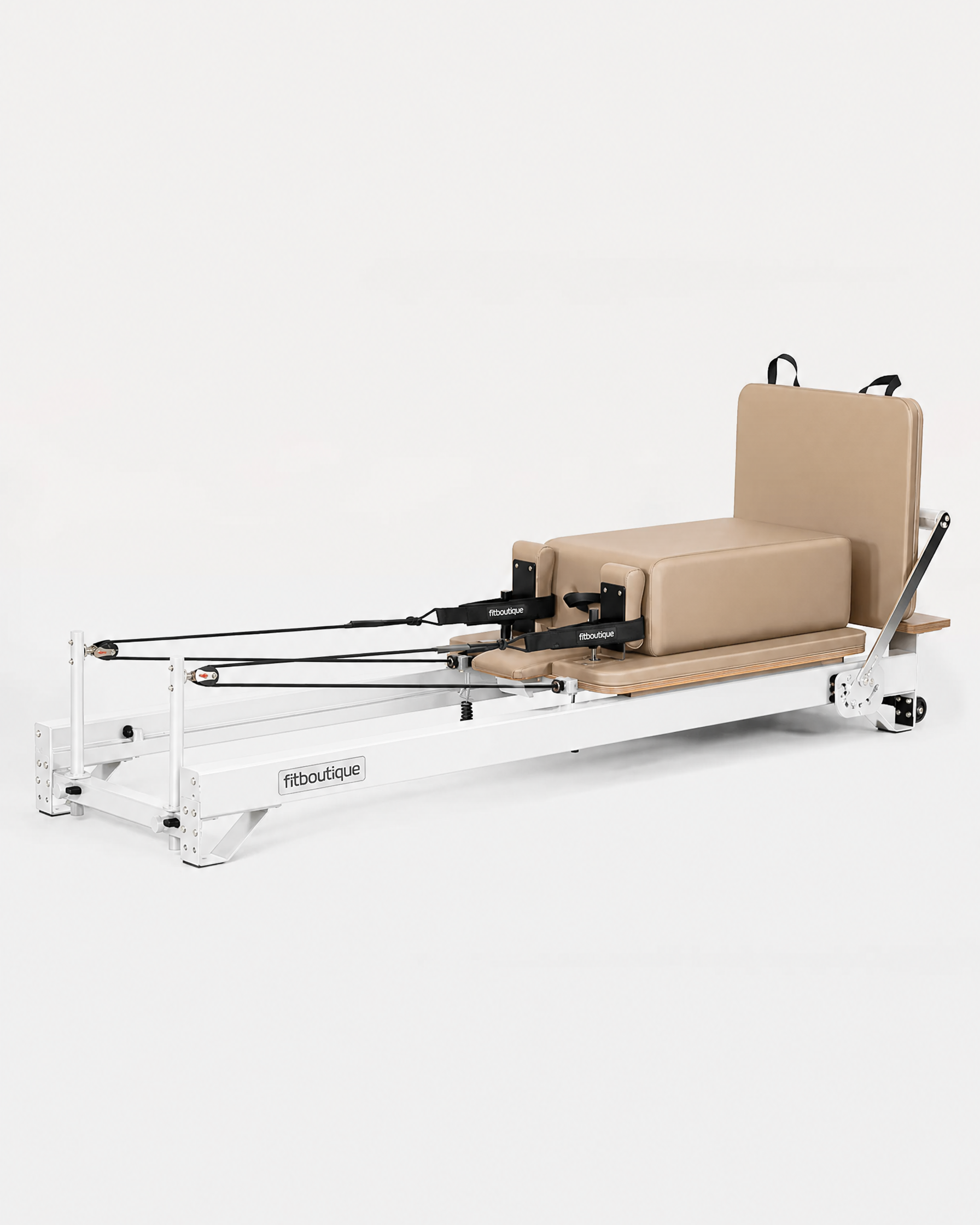
If you are on your own reformer at home, our reformer Pilates warm up is a good way to open your first few sessions, and the 15 minute reformer Pilates workout makes a sensible first full session back.
A 4 week return plan
This works for most people coming back after a month or more away. Adjust the number of sessions to your life, but keep the shape.
Week 1. Reconnect. 2 sessions of 15 to 30 minutes. Lighter springs, lots of footwork, breathing and basic core work. The only goal is to finish both sessions.
Week 2. Rebuild. 2 or 3 sessions of 30 minutes. Bring back straps work and bridging. Add a spring to your footwork if the last reps felt easy.
Week 3. Reload. 3 sessions, one of them a full length class. Start returning to your old springs on the exercises where you feel controlled. Leave the hardest exercises until the last session of the week.
Week 4. Return. 3 sessions at close to your old level. Bring back the exercises you left out in week 1. By the end of this week most people are training normally again.
The easiest way to follow a plan like this is to let something else make the decisions. A structured program means you never have to ask yourself what to do today, which is exactly the question that stops people on a restart.
Fit by FitBoutique
Restart with the 28 Day Reformer Reset
The Fit app has a structured 28 Day Reformer Reset with a clear weekly plan, plus 10 minute resets for busy days and full classes for when you are back to strength. Real instructors cue every movement and every spring change. Try it free for 7 days.
Start Your Free TrialComing back after injury, illness or pregnancy
If your break was because of an injury, surgery, illness or having a baby, the rules change. Get clearance from your doctor or physiotherapist before you start, and ask them specifically about anything you should avoid. Your return should be guided by what your body is ready for, not by how long it has been.
Tell your instructor what happened if you are going back to a studio. If you are training at home, be even more conservative with springs and range than the plan above suggests, and stop anything that causes pain rather than discomfort.
We have more detail on coming back in specific situations in reformer Pilates during pregnancy and postpartum and reformer Pilates with a bad back.
Why restarts fail, and how to make this one stick
Restarts rarely fail because people are not strong enough. They fail for 3 reasons, all of them avoidable.
All or nothing thinking. You plan 4 sessions a week, miss one, decide the week is ruined and stop. Plan for fewer sessions than you think you can manage and count a 10 minute session as a session.
Too much too soon. A heroic first session leaves you so sore that the second one never happens. The first week should feel almost too easy.
No plan. Without a plan, every session starts with a decision, and decisions are where motivation leaks away. Decide the week on Sunday and the rest takes care of itself. Our guide on staying motivated with Pilates at home has more on this.
A Note From Ayrah
Every time I have come back after time off, the first session has been easy. It is the third one that nearly stops me.
The first session is all fresh motivation. The second is still new enough to feel good. By the third, the soreness from session 1 has fully landed, the novelty has gone, and it is a Tuesday night and I am tired.
So now I book all 3 before I do the first. Day, time, which class, written in my calendar like a meeting. When the third one comes around I do not have to decide anything, I just have to turn up.
Once I am past session 3, I have never failed to make it to week 4.
Frequently Asked Questions
How do I get back into Pilates after a long break?
Start with shorter classes, lighter springs and 2 sessions a week, then build up over about 4 weeks. You keep your technique and body awareness for a long time, so the main job is rebuilding strength and endurance without overloading muscles that have not worked hard for a while.
How much Pilates fitness do you lose after a break?
Less than most people expect. Technique and body awareness stay with you, while strength and endurance drop the longer you are away. After a few weeks off the difference is small. After several months you will notice it, but you will rebuild faster than you built it the first time.
Should I go back to the same springs?
Not straight away. Drop one spring on heavier exercises for your first week or 2 and add load back as the last reps of each set start to feel controlled.
How long does it take to get back to my old level?
After a short break, a week or 2. After a few months off, most people are back to normal within about a month of consistent training. After a year or more, allow longer and treat it as a fresh start.
Will I be really sore when I come back?
Probably a bit sore after the first few sessions, which is normal. Keeping the first week short and light is the best way to avoid being so sore that it stops you training.
Can I come back to Pilates at home rather than in a studio?
Yes, as long as you have some previous experience and no injury that needs supervision. A structured program in an app gives you a plan to follow and instructors who cue you through each movement and spring change.
Start Again, The Easy Way
A 28 day structured reset, 10 minute sessions and full classes from real instructors. Start with 7 days free.
Start Your Free Trial
Written by Ayrah Yuso
I'm part of the FitBoutique team and have a solid passion (and love) for all things exercise related, including Reformer Pilates

















Leave a comment